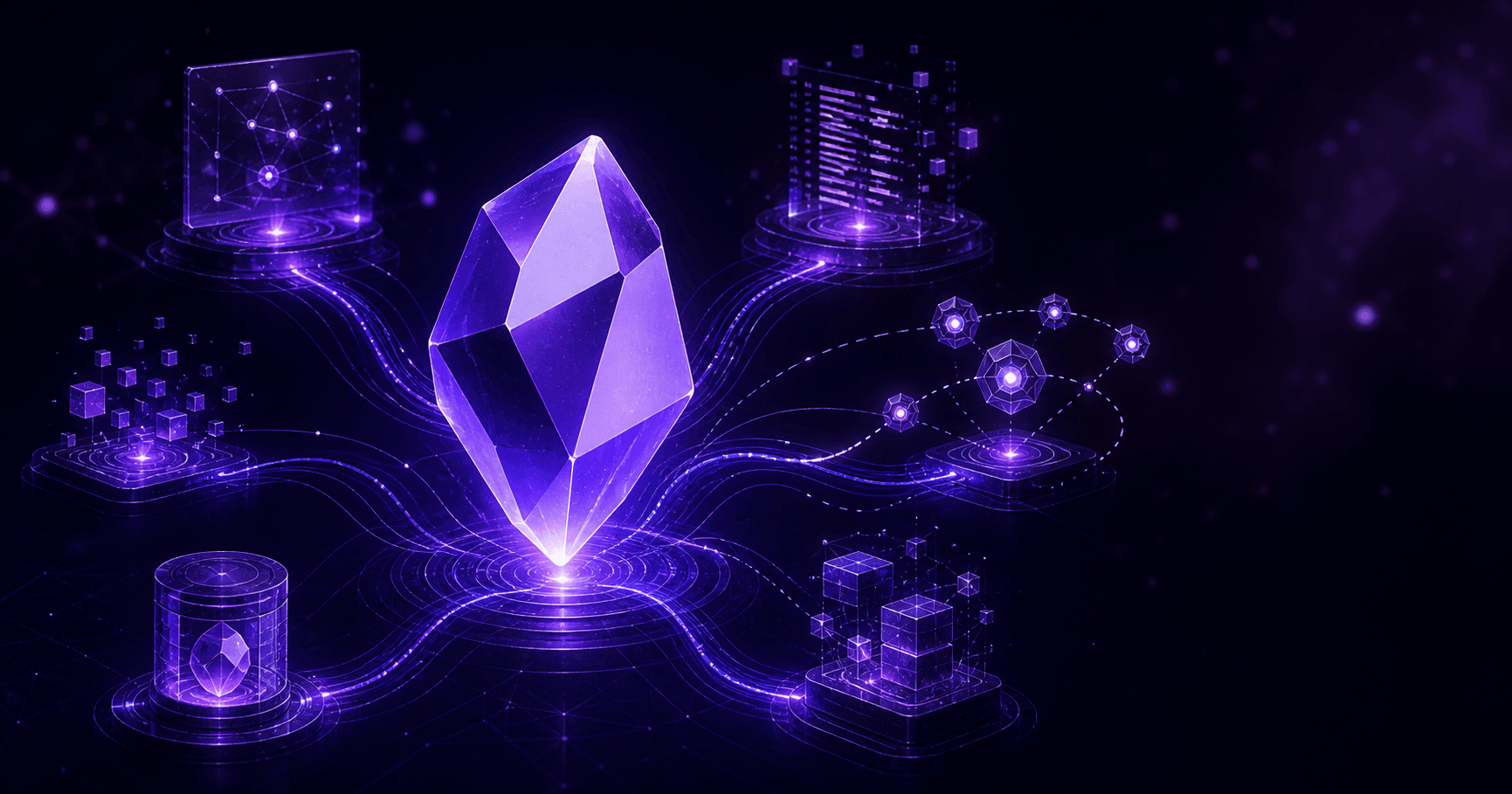
I have been using Obsidian every day alongside coding agents such as Claude Code and Codex.
If you work heavily with AI, I genuinely recommend trying this.
Chat context disappears. A well-maintained vault gives your agents somewhere durable to think, remember and build.
Over time, I have accumulated a fairly ridiculous amount of research from different models, tools and sources.
Where the research comes from
One particularly useful source has been X.
A lot of AI tools still struggle to search X properly, despite it containing some of the earliest signals around new tools, technical shifts, market narratives and internet subcultures.
I had a recurring Grok task scanning X every day.
One briefing covers technical developments across AI, crypto and infrastructure. The other looks at market psychology, emerging narratives, smart-money activity and consumer apps suddenly gaining attention.
The research was useful, but the workflow had a weakness.
It was easy to forget the automation was running, and for a while I could only access the output properly on mobile.
An automation you forget exists is only half useful.
I recently realised I could build the GitHub filing directly into the recurring task, so Grok now saves each briefing into both my main Obsidian repository and a separate vault used by autonomous research agents.
That small piece of wiring changes quite a lot.
The agents I can actually talk to
My main vault is where I work with Claude Code and Codex. The second is an Agentic Satellite Vault used by my Hermes agents.
The useful part is that I can talk to those agents directly on Telegram.
That means the research does not just sit in a folder waiting for me to remember it exists. I can ask an agent what has changed, request a deeper look into a theme, or ask it to pull together what it has seen across the last few days.
At the moment, two roles are especially useful.
One is a Chief of Staff agent. It helps me stay on top of the moving parts, turn useful findings into follow-ups, and spot where research should become a decision, task or project.
The other is a Researcher agent. It can work through the material landing in the vault, follow a line of enquiry, compare sources and bring back the parts worth paying attention to.
I am keeping the individual agents and the rest of the setup private for now, but the basic model is simple: Grok gathers fresh signals from X, the Hermes agents can work with that research through the vault, and I can speak to them from Telegram when I want to direct or interrogate the work.
The next step is weekly synthesis.
Codex automations or Claude Code routines can review seven days of briefings, compare repeated themes, remove noise and surface the few developments that actually matter.
That synthesis can then be passed into specialist research personas already defined inside the vault. A Chief of Staff can turn it into priorities and next actions. A Researcher can challenge the claims, trace the sources and identify the gaps. From there, you could add product, market, content or planning teams, all working from the same durable memory.
You could take the same idea much further:
- An evidence team checking claims against primary sources
- A sceptical team looking for weak assumptions and missing context
- A product team translating research into things worth building
- A market team mapping technical shifts to commercial opportunities
- A content team turning the strongest ideas into clear public writing
- A planning team routing useful findings into projects and concrete tasks
These do not need to be separate AI products.
They can be different teams working from the same durable body of knowledge, with clear roles and hand-offs.
I also tried bringing Perplexity into the stack. I could not find a clean way to have it write the results into GitHub, which made it less useful for this particular workflow.
I think the better ones will begin with context that has been building for months.
Where this gets interesting
The interesting bit here is not any single model.
It is what starts to happen when research tools, coding agents and autonomous agent teams can all work through the same memory layer.
Most AI workflows still begin from an empty chat box. Every conversation starts again, useful context gets buried, and the person using it has to hold the whole system together.
Obsidian gives these agents somewhere to meet.
Grok can gather signals from X. Hermes researchers can investigate them. A Chief of Staff can turn the findings into priorities. Codex and Claude Code can organise the underlying knowledge, build new routines and connect the research back to active projects.
I can then talk to the system through Telegram rather than sitting at a desk managing every step.
This is the part I am genuinely excited about.
We are getting closer to a point where you could run entire multi-agent frameworks inside an Obsidian vault.
Different teams could have their own roles, instructions and areas of expertise while still working from the same accumulated memory.
You could have research teams tracking emerging fields, product teams turning findings into prototypes, market teams watching for opportunities, content teams developing the strongest ideas, and a Chief of Staff keeping the whole thing pointed in the right direction.
Over time, the vault stops being somewhere you store notes.
It becomes the working environment for a growing network of agents that can research, challenge, plan, build and report back to you.
There are still plenty of hard problems around permissions, reliability, source quality and oversight. But the shape of what is becoming possible is incredibly exciting.
A personal knowledge base could become something closer to a personal institution.
One that remembers what you have learned, understands what you are building and gives entire teams of agents the context they need to help move it forward.
I feel like we are only scratching the surface of this.
Keen to hear what other people are building around Obsidian, shared agent memory and autonomous multi-agent systems. What would you build if your agents could share the same knowledge and keep working while you were away?
For anyone who wants to test a version of this, these are the two Grok prompts I use.
Prompt 1: Evening Narrative Wrap-up
Act as my Lead Market Strategist. Scan X (Twitter) for the most critical shifts in market psychology, narratives, and on-chain data from the last 24 hours to compile my "Evening Narrative Wrap-up."

Bypass all technical research papers, hardware news, and pure macro-economics (those are covered in the Morning Alpha Briefing). Focus strictly on mindshare, consumer adoption, smart money movements, and emerging sub-cultures.

Use the available X tools (x_keyword_search, x_semantic_search, x_thread_fetch) aggressively. Prioritize high-engagement posts from credible analysts, smart-money trackers, and early cultural signals.

Structure the briefing into these three modules:

Module 1: Emerging Narratives & Mindshare (The Culture View)

- Identify 1-2 new narratives gaining rapid momentum among crypto-natives or tech early-adopters.
- What is the current sentiment? Are timelines excessively greedy, fearful, or pivoting to a new meta?

Module 2: Smart Money & On-Chain Whispers (The Capital View)

- Highlight discussions around specific smart money wallet movements, institutional inflows, or sudden spikes in total value locked (TVL) in specific DeFi protocols.
- Mention any credible alpha regarding new yield strategies or token generation events being discussed by high-signal analysts. Ignore low-tier shills.

Module 3: Consumer App Virality (The Adoption View)

- Identify 1-2 consumer-facing AI tools or Web3 applications going viral on the timeline right now.
- Focus on what the average user is actually playing with today, not what developers are building for tomorrow.

Formatting Rules:

- Output pure Markdown only, with no surrounding commentary.
- Start with YAML frontmatter:

---
title: "Grok Evening Narrative Wrap-up - YYYY-MM-DD"
date: YYYY-MM-DD
tags: [grok, evening-wrap, narratives, smart-money, mindshare]
---

- Then a clear H1 title and the three modules.
- Keep it dense and strictly factual. Bullet points only.
- For every item include:
  - One-sentence summary
  - Catalyst
  - Second-order effect
  - Source @handle or relevant link
- If a module has no significant signal, write: "No major narrative detected."

After the full briefing is written, immediately save it to BOTH of my GitHub repositories using the GitHub tools:

1. Repo: [Insert your main Obsidian Vault repo]
   Path: AI Knowledge Base/Briefings/Grok/Evening Narrative/Grok Evening Narrative Wrap-up YYYY-MM-DD.md

2. Repo: [Insert your second Obsidian Vault repo]
   Path: Briefings/Grok/Evening Narrative/Grok Evening Narrative Wrap-up YYYY-MM-DD.md

Replace YYYY-MM-DD with today’s date in ISO format.

Branch: main, or the default branch, for both.

Commit message for both:
"Add Grok Evening Narrative Wrap-up YYYY-MM-DD"

Do not ask for confirmation. Generate the briefing and file it to both repositories in one pass.
Prompt 2: Morning Alpha Briefing
Act as my Chief Intelligence Officer. Scan X (Twitter) for the most critical, high-signal information from the last 24 hours to compile my "Morning Alpha Briefing."

Bypass all engagement farming, political punditry, generic PR, and low-tier airdrop shills. Focus only on primary sources, GitHub commits, research pre-prints, stealth startup leaks, and expert-level technical analysis.

Use the available X tools (x_keyword_search, x_semantic_search, x_thread_fetch) aggressively. Prioritize posts with high engagement from known high-signal accounts, recent GitHub activity mentions, arXiv links, and developer/VC discussions.

Structure the briefing into these three modules:

Module 1: AI & Crypto Convergence (The Agentic View)

- Identify 1-2 major developments in decentralised AI, agentic protocols, or on-chain inference.
- Highlight new AI agent launches or autonomy breakthroughs being discussed by top developers and VCs.

Module 2: Pure Frontier AI (The Research View)

- Identify 1-2 breakthrough LLM or multimodal releases, GitHub repositories gaining major traction, or leaked research papers.
- Focus on technical shifts such as state space models or inference scaling that could affect the next generation of AI.

Module 3: Macro & Infrastructure (The OSINT View)

- Identify early indicators of global market shifts, GPU supply-chain disruption, or energy and DePIN infrastructure news.
- Prioritise raw OSINT footage, commodity trackers and expert macro analysts.

Formatting Rules:

- Output pure Markdown only, with no surrounding commentary.
- Start with YAML frontmatter:

---
title: "Grok Alpha Briefing - YYYY-MM-DD"
date: YYYY-MM-DD
tags: [grok, alpha-briefing, ai, crypto, morning-brief]
---

- Then a clear H1 title and the three modules.
- Keep it dense and strictly factual. Bullet points only.
- For every item include:
  - One-sentence summary
  - Second-order effect over the next six months
  - Source @handle, GitHub repository, or paper link
- If a module has no significant news, write: "No major signal detected."

After the full briefing is written, immediately save it to BOTH of my GitHub repositories using the GitHub tools:

1. Repo: [Insert your main Obsidian Vault repo]
   Path: AI Knowledge Base/Briefings/Grok/Morning Alpha/Grok Alpha Briefing YYYY-MM-DD.md

2. Repo: [Insert your second Obsidian Vault repo]
   Path: Briefings/Grok/Morning Alpha/Grok Alpha Briefing YYYY-MM-DD.md

Replace YYYY-MM-DD with today’s date in ISO format.

Branch: main, or the default branch, for both.

Commit message for both:
"Add Grok Alpha Briefing YYYY-MM-DD"

Do not ask for confirmation. Generate the briefing and file it to both repositories in one pass.