AI Industry Analysis, March 2026
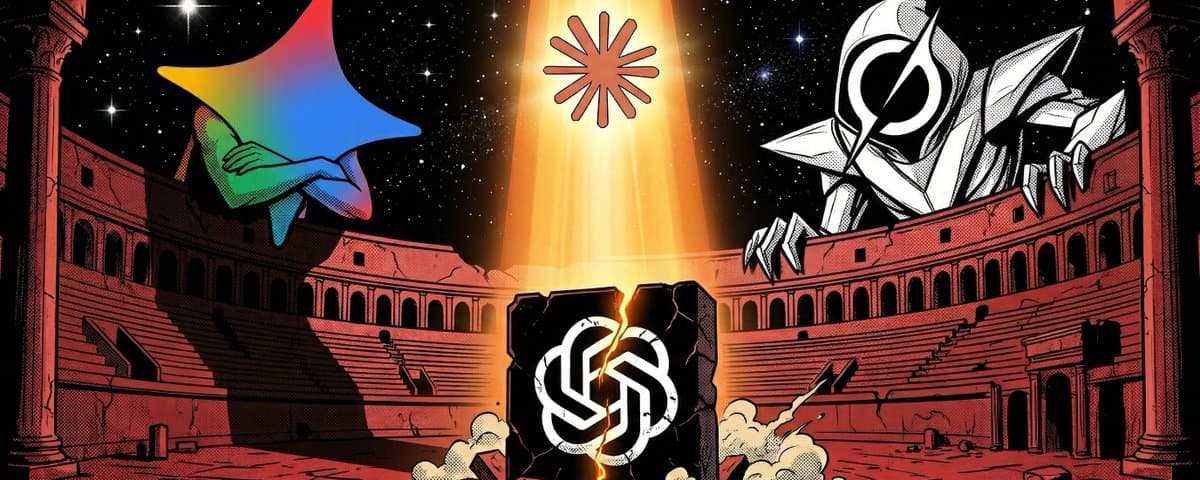
Full disclosure: I ran a structured research prompt across four frontier models, asking each to assess OpenAI’s market position, competitive threats, and three-to-five-year outlook.
What came back wasn’t the usual AI cheerleading or corporate hedging. It was contrarian, occasionally brutal, and in one case, weirdly self-aware.
Here’s what each said, and what it actually means.
The responses
Gemini 3.1 Pro, Deep Research Mode
Verdict: Transitional pioneer.
“OpenAI is the Netscape of the AI era. They ignited the revolution and own the defining consumer brand, but they lack the structural physics required to win the endgame.”
Google’s own model, assessing a rival. Remarkably uncharitable given the source. The “middleware renting compute at a premium to sell intelligence at a discount” framing is the sharpest one-liner in the whole experiment.
Grok 4.2, Expert Mode
Verdict: OpenAI losing where it counts.
Anthropic now holds 40% of enterprise LLM spending, according to Menlo Ventures’ enterprise survey, up from 24% in 2024. OpenAI has slipped to 27%. New enterprise wins go to Anthropic 70% of the time.
Elon’s model spent most of its answer praising Anthropic. Grok basically said “OpenAI is cooked in the part of the market that actually pays.” The Claude Code stat, zero to $2.5B ARR in nine months, hit like a grenade. Whether Grok was being objective or just contrarian by nature is left as an exercise for the reader.
Claude Sonnet 4.6, Research Mode
Verdict: Extraordinary momentum, extraordinary fragility.
Much of OpenAI’s 2026 mega-round financing is circular. Nvidia’s contribution is dedicated GPU compute capacity that flows straight back to Nvidia as compute purchases. The money raised and the money spent are largely the same money.
Full transparency: this is Anthropic’s model assessing a competitor, so take it with appropriate salt. That said, the circular financing observation was the sharpest structural insight of the four. No other model flagged it. OpenAI raises $120B+, a chunk of which flows straight back to the investors as compute spend. That’s not fundraising. That’s a very expensive revolving door.
ChatGPT 5.4, Deep Research and Thinking Mode
Verdict: Famous transitional player risk.
OpenAI’s “ARR” of $20B+ and its actually reported 2025 revenue of roughly $13B are not the same number. This distinction matters more than the headline.
Was ChatGPT nice to itself? Fairer than you’d expect. Call it 7/10 on the self-awareness scale. It flagged the ARR versus actual revenue gap, noted its own gross margin deterioration, and put the bull case probability at just 15% to 20%. It also buried its best insight somewhere around paragraph fourteen: inference routers dynamically pricing to the cheapest “good enough” model are more threatening than any single competitor. Points for honesty, deducted for density.
The thing that should worry you
Two models, Gemini and Claude, independently reached for the Netscape metaphor without seeing each other’s answers.
When two competing AI systems built by rival companies converge on the same historical comparison with no coordination, that’s not a coincidence. That’s a signal.
Netscape built the browser. Defined the category. Had the consumer brand. Then got outmanoeuvred by better-distributed players who didn’t need to win on merit. They just needed to ship with Windows.
The OpenAI parallel is obvious. ChatGPT built the category. 900M weekly users. But Google ships with Android. Apple Intelligence ships on the iPhone. Microsoft is building its own MAI models as an OpenAI alternative while simultaneously collecting a 20% revenue share through 2032. The distribution layer is closing in from every direction.
The number nobody is talking about: OpenAI’s adjusted gross margin fell from roughly 40% in 2024 to 33% in 2025, as the company scaled. Margins are moving in the wrong direction at exactly the moment they need to move right. A business that burns more per dollar of revenue as it grows isn’t converging toward profitability. It’s drifting away from it.
Where the four models disagreed
Bull case probability
- Gemini: 20%
- Grok: 35%
- Claude: 15% to 20%
- ChatGPT: 15% to 20%
Three of four models gave the optimistic scenario less than one-in-five odds.
Biggest threat
- Gemini: Open-source commoditisation
- Grok: Anthropic’s enterprise takeover
- Claude: Circular cost structure
- ChatGPT: Inference routers and distribution lock-out
On the Microsoft partnership: All four agreed it’s simultaneously OpenAI’s greatest distribution asset and a structural tax on growth. The 20% revenue share through 2032 costs $13B+ in 2026 and 2027 alone.
On the $850B valuation: Consensus across all four. Priced for a world where most things go right. The margin of safety, in ChatGPT’s own words, is “uncomfortably thin.”
My take
OpenAI is not cooked. But the recipe has changed and they don’t fully own the kitchen anymore.
The consumer brand is real. 900M weekly users don’t evaporate overnight. The infrastructure commitments, Stargate, the Amazon deal, the Oracle partnership, are physical bets that take years to unwind. And agentic AI, if it delivers on even half its promise, could flip the unit economics entirely.
But the structural reality is harder to ignore. OpenAI doesn’t own the silicon, the devices, or the operating systems. It rents compute from the same hyperscalers competing against it. Its best enterprise customers are already routing simpler tasks to cheaper open-weight models. Gross margins are declining as the company scales. And it needs to grow from $13B to $100B in revenue in three years, a feat with no historical precedent, just to justify where it’s currently priced.
The verdict: OpenAI will survive. It will probably be very large and very valuable. But the $850B valuation implies it becomes the defining infrastructure layer of the AI era, the AWS of cognitive labour. The evidence across four models with zero coordination between them points to a more likely outcome: one of three or four major platforms, grinding for margin in an increasingly commoditised market, wearing the Netscape comparison like a warning label it can’t quite shake.
The most interesting thing about this experiment wasn’t the analysis. It was the convergence. Four models, built by four competing companies, with every possible incentive to spin in different directions, and they all landed in roughly the same place.
That might be the real signal.
Infrastructure monopoly or transitional pioneer? Drop your take below.