
For the last few years, the AI industry has behaved as if there is one prize: build the most powerful frontier model on Earth.
That race has produced extraordinary technology. It has also produced eye-watering training bills, heavy inference costs and a release cycle where a technical lead can disappear within weeks.
I am starting to wonder whether the frontier model race is not just a race, but a trap.
Apple may look clever for arriving late
Apple has been criticised for being late to AI, and I often get astonished at how bad Siri is. But it has never needed to win a public benchmark every few months. It owns the device, the operating system, the silicon, the distribution and the relationship with the user.
Its latest approach makes the bet clearer. Apple now has a family of on-device and private-cloud foundation models, including models built with Google, but it still is not trying to become the default frontier API for the entire internet.
If strong models become cheaper and more interchangeable, Apple can buy, partner or build what it needs, then make the intelligence useful inside products it already controls. That may prove more durable than spending tens of billions to hold the benchmark crown for a quarter.

Google may be playing a broader game
I do not think Google has literally left the frontier race. Sundar Pichai says Gemini 4 is its most ambitious pre-training run yet. Google still has DeepMind, world-class researchers, its own chips, vast data and products used by billions of people.
But the organisation is changing. Demis Hassabis has moved from the day-to-day leadership of DeepMind to become its chairman and Alphabet's chief scientist, while Koray Kavukcuoglu has taken operational leadership. Jeff Dean and several other senior researchers have also left. Google described the reshuffle as its next chapter of AI momentum.
My read is not that Google has given up. It is that Google can afford to care less about winning the frontier race in only one dimension.
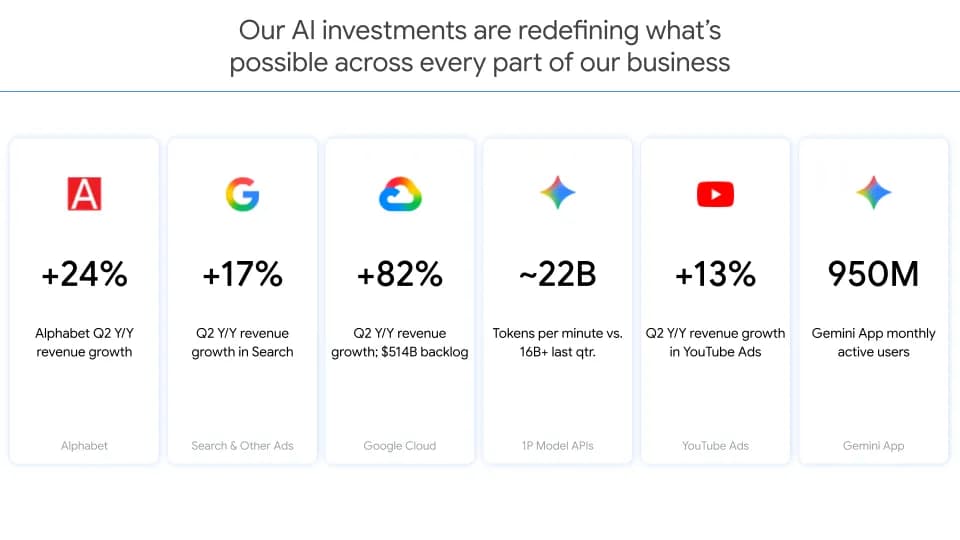
It can make enormous money supplying the race. In Q2 2026, Google Cloud revenue grew 82%, its backlog reached $514 billion and its model APIs processed roughly 22 billion tokens per minute. Chips, cloud, models, data, security and agent platforms all reinforce each other.
The winner of a gold rush is not always the person who finds the biggest nugget. Sometimes it is the company selling compute to everyone digging.
Chinese open models change the maths
The largest threat to OpenAI and Anthropic may not be one better closed model. It may be a steady flow of capable open-weight models that companies can run, tune and control themselves.
DeepSeek was the obvious shock, but the story is much wider: Qwen, Kimi, MiniMax, GLM and others are pushing capability while paying close attention to efficiency and deployability. Hugging Face's review of the Chinese ecosystem describes a market moving towards mixture-of-experts architectures, permissive licences, smaller practical models and full deployment stacks rather than isolated model releases.
That matters because most businesses do not need the smartest possible model for every task. They need one that is good enough, affordable, adaptable and permitted to run where their data lives.

Is distillation the trap?
This is where the Ackbar meme earns its place.
Frontier labs spend enormous sums discovering new capabilities. Soon afterwards, smaller models learn to reproduce a useful share of those capabilities through distillation, synthetic data, better training recipes and ordinary engineering.
That does not make frontier research pointless. Somebody still has to push the ceiling. But it may make the economics brutal: the lab pays to discover the capability, then the market rapidly turns much of it into a cheaper feature.
The Stanford AI Index has already shown how quickly performance gaps narrow while the cost of using capable models falls. If that pattern continues, maintaining a durable technical moat becomes extremely difficult.
Meta matters here. Its open-weight strategy has never been pure charity. By releasing Llama, Meta helped make the model layer more available and less strategically controlled by a handful of API providers. Meta's own frontier AI framework argues that openness supports competition, innovation and national strength, while still placing limits around severe risks.
SpaceXAI is moving further into the fight
At the other end of the spectrum, Elon Musk appears to be leaning further into the frontier race.
SpaceX combined with xAI and moved to acquire Cursor, bringing models, enormous compute, rockets, connectivity and one of the most important AI coding products into the same orbit. Grok 4.5 was trained alongside Cursor, with SpaceXAI positioning it around coding, agentic tasks and knowledge work.
The release tempo is also aggressive. Musk has publicly outlined another rapid sequence of larger Grok models. His timelines should always be treated as targets rather than laws of physics, but the intent is obvious: more compute, faster iterations and a deeper push into agentic software.
This is not a side project any more. SpaceXAI is increasingly one of the organisations willing to keep spending at the frontier, with strategic assets that most standalone labs simply do not have.
Does this burst the AI bubble?
Possibly parts of it.
If model intelligence becomes cheaper faster than labs can build defensible distribution, some valuations will look very difficult to justify. Astronomical inference costs are not a viable foundation for every product, especially when a good open model can do the job locally or through a lower-cost provider.
But cheaper intelligence could also be what makes the market real.
Powerful open-weight models let companies control data, customise systems and avoid being trapped by one supplier. They make local agents, private enterprise deployments and products with sensible unit economics much more practical. Commoditisation may hurt some model providers while creating a far larger software and services market above them.
Personally, as soon as the hardware becomes remotely sensible, I want to build a proper AI rig at home.
Not just for one local model. I want to see how large an agentic fleet I can run on it: researchers, builders, critics and a Chief of Staff, all working from shared memory without every task becoming another cloud bill. The thought of that running quietly at home is genuinely exciting.
It would be useful for privacy, experimentation and learning. I could also use it to play games, if I ever find the time.
The next three years
My guess is that frontier models will not disappear. They will become more strategic and more concentrated.
A small number of labs, hyperscalers and state-backed programmes will keep pushing the absolute ceiling. Below them, open-weight and distilled models will spread capabilities quickly, becoming cheaper and easier to run. Most companies will mix both: frontier APIs for the hardest work and controlled, efficient models for everything else.
Nation states are one reason this train is unlikely to stop soon. The US now treats advanced AI and compute as national-security infrastructure. Europe is building AI Factories. China is explicitly linking AI development to economic and strategic competition. Even if private capital becomes less enthusiastic, governments are unlikely to decide that frontier capability no longer matters.
So can the frontier labs win?
Yes, but probably not by having the best model alone.
They need distribution, products, trust, proprietary data, developer ecosystems and infrastructure economics that survive when yesterday's miracle becomes tomorrow's open-weight download.
The valuable position may be owning the place where intelligence is used, the hardware it runs on, or the workflow it improves. The model still matters. It may simply stop being the whole business.
That is a very different race.
And we also just want to see AGI bring abundance, right?